No, AI progress is not plateauing
Instead, AI capabilities are improving faster than we can evaluate them
My motivation for writing this post was a few conversations I recently had where the perception was that AI capabilities have been plateauing, followed by me explaining why that wasn’t the case. It’s hard to stay aware of the progress unless you follow closely, so I thought I’d make the case for continued AI progress, why there’s no end in sight, and why more people should be aware of this.
One of the biggest challenges in AI today is that the AI models are getting smarter faster than we can evaluate them.
While this sounds grandiose, there are a few ways I can make the case for this, with the best and most recent example being FrontierMath. FrontierMath is a benchmark to evaluate ability at math, and its authors described it as a brutally difficult benchmark with problems that would stump many mathematicians. So what’s hard about it? It is a benchmark built to evaluate performance of AI models on extremely hard math questions, ones which require deep expertise in multiple domains of mathematics.
Why was this created? Because the existing benchmarks we have to evaluate AI capabilities like MMLU (Measuring Massive Multitask Language Understanding, which was created in 2020) have been saturated by AI progress, meaning they’ve hit close-to-maximum performance so the benchmark is no longer a good metric to evaluate improvement in capabilities of LLMs.
Benchmark saturation has lately become a common phenomenon at an increasingly faster rate, necessitating the need for new benchmarks that can stand longer in face of accelerating AI capabilities.
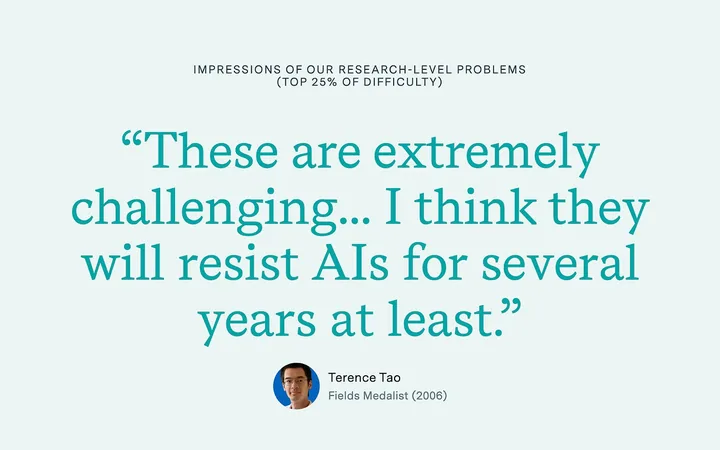
The creators of FrontierMath set out to build exactly that, hoping that the benchmark could stand at least a couple of years of advancement in AI capabilities. They involved extremely talented mathematicians, including Fields Medalists (which is the math-equivalent of Nobel Prize) to create this benchmark.
Here’s Terrence Tao, a Fields Medalist, describing his thoughts on how he expects AI to do on this benchmark:
And to their credit, they actually created a really difficult benchmark – when they released this benchmark, even the smartest AI models were only able to solve 2% of the problems. This was two months ago, in November 2024.
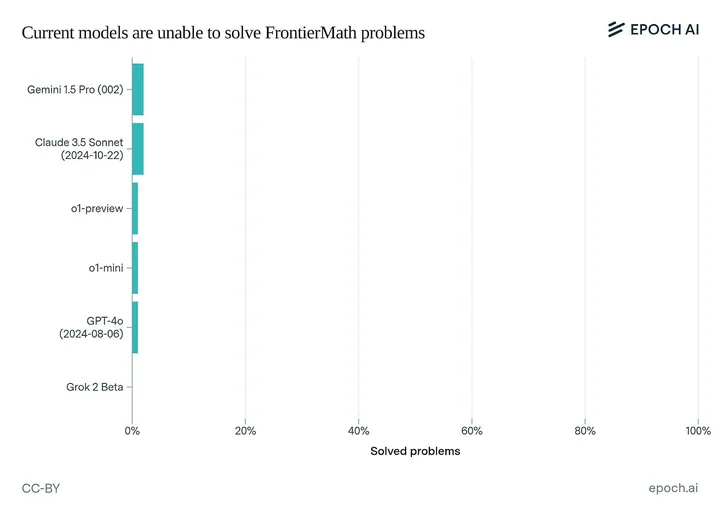
Great so far. Except, OpenAI announces o3, their smartest model at coding and math, a month later in December 2024, and how did it do at FrontierMath?
o3 hit 25% – which even the FrontierMath’s creators expected to be a year away.

Similarly, here’s another long-standing benchmark ARC-AGI. This was built such that only systems that can adapt to new problems it has not seen before will do well. This benchmark withstood AI progress for the last 5 years, with AI capabilities improving slowly, until suddenly the benchmark was almost saturated..
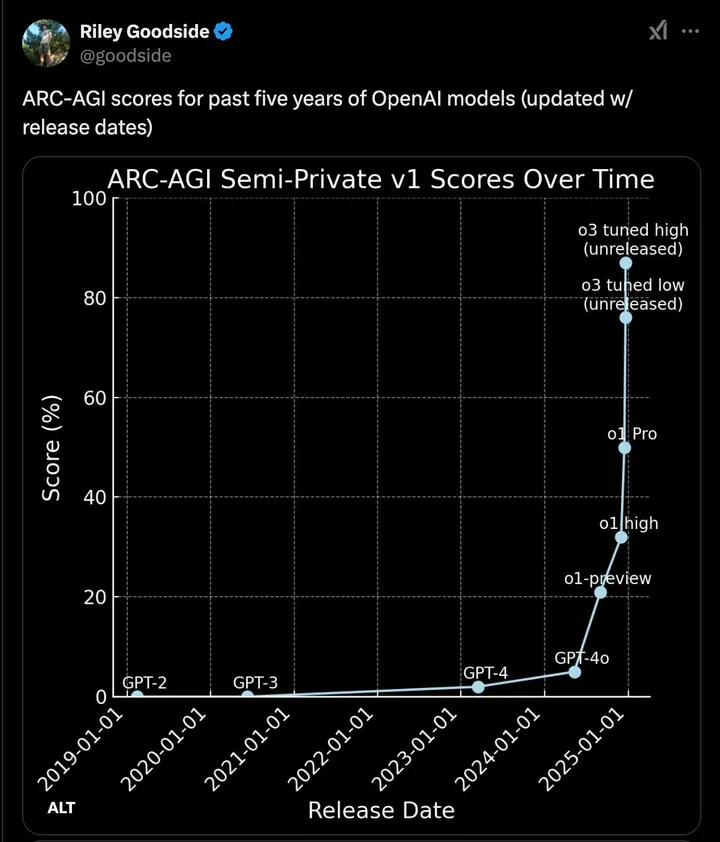
Now the consensus among AI labs and people working at the frontier of AI is to create even harder benchmarks, and to do it fast. But before we go there, I want you to look at one question from FrontierMath to understand what we’re dealing with here:
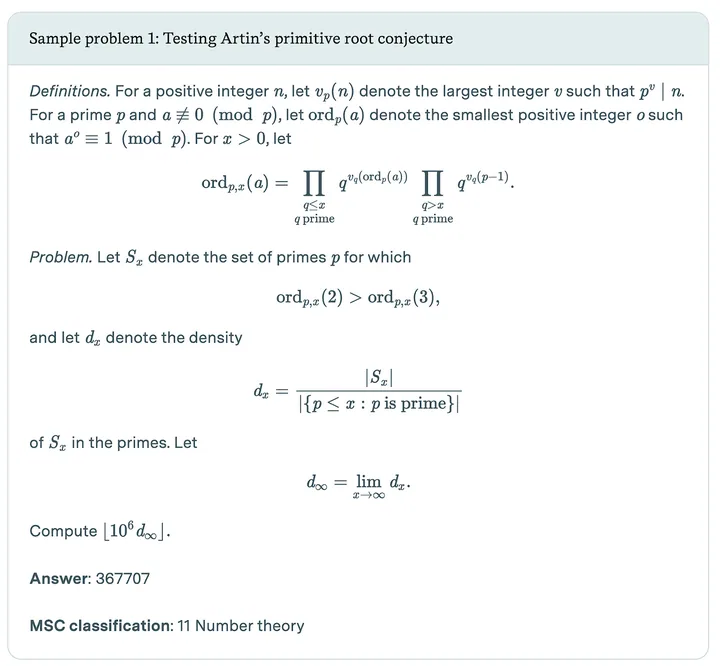
To put this problem in perspective: it’s asking about properties of prime numbers that require understanding multiple advanced mathematical concepts simultaneously – number theory, abstract algebra, and infinite series. Even for professional mathematicians, these problems require creative insights that typically come from years of specialized study. Yet an AI system can now solve a quarter of such problems – a feat that would qualify it as an exceptional mathematician if it were human. (funnily enough, I had Claude, an AI, describe this problem as well).
Here’s another problem:
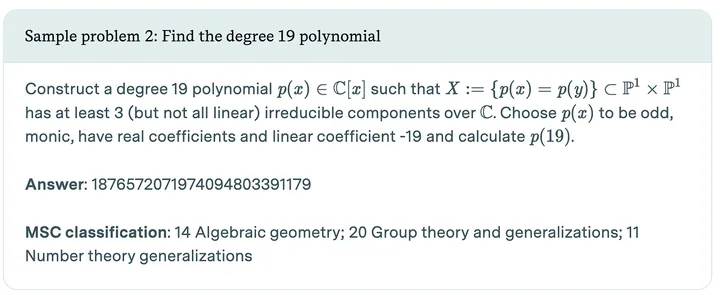
>99.9% of the population cannot solve >1% of questions in FrontierMath, and we now have an AI that has solved 25% of it. 5 years ago, the state-of-the-art in AI was GPT-2, which could sometimes write fully coherent paragraphs in English.
Where will we be in the next 5 years?
There’s no way to precisely answer that, but to describe what’s possible, I need to introduce test-time compute, introduced with OpenAI’s o1 model, which unlocks a new paradigm in scaling AI capabilities.
Previously, we relied on scaling the amount of compute spent during training of AI models (i.e., pre-training), meaning that the more compute spent during training, the better the model generally gets. But training requires several orders of magnitude higher compute than test-time (aka inference, i.e., when you’re using chatGPT), requiring that many more GPUs for that much longer.
So what’s the new paradigm? It’s that we’ve figured a way to improve capabilities of AI, given the same trained model, by just giving it more time to think. Let it think about a problem for 1 hour instead of a minute, and get a significantly better answer. This is remarkable because for the same trained model, its capabilities improve the more time you give it to think. And test-time compute scaling is much faster than pre-training scaling, because inference currently requires much less compute.
This means that training a model for a long time on more data is no longer the only way AI gets smarter. Instead, you can take a given model, give it more compute during inference, and let it think for longer to achieve better performance.
This essentially means that you should expect the progress to accelerate (for instance, OpenAI went from o1 to o3 in a couple of months; in contrast GPT-3 to GPT-4 took 3 years), and consequently consider what the possibilities are.
So the next time you use chatGPT, it may feel roughly similar to how it did when you first used it when it released 2 years ago, but remember that that’s not an indication that the capabilities have plateaued. It’s just that it is getting harder to evaluate their capabilities, and not only did the progress not stop, it is accelerating.

If you’re interested in further reading, I recommend these:
Machines of Loving Grace, by Dario Amodei, the CEO of Anthropic. Dario talks about what the progress in AI could mean for humanity’s progress. Anthropic, for those unaware, is OpenAI’s competitor, and currently has the best AI model across several benchmarks.
The Intelligence Age, by Sam Altman, the CEO of OpenAI. Sam similarly talks about what progress in AI would mean for humanity.
Another post which goes into detail on what the impact of a generally intelligent AI would look like.
Finally, Killed by LLM, which covers all the benchmarks that LLMs have defeated over the years.